
AI Strategy & Compliance
Minimize business risk by providing information
Why information and knowledge are becoming increasingly important in companies and how they influence business risk.
Data growth has never been as fast as it is today, and technologies have never developed as quickly as they do today. In addition, new working models through New Work require a new approach and handling of knowledge and data by companies and employees.
Decisions beyond the bottom line
When decision-makers in companies make decisions today, they often have the bottom line in mind at the end of the day. In recent years, however, economic, social and governance (ESG) issues have increasingly joined the bottom line as an extension of corporate social responsibility (CSR) that cannot be assessed with hard numbers.
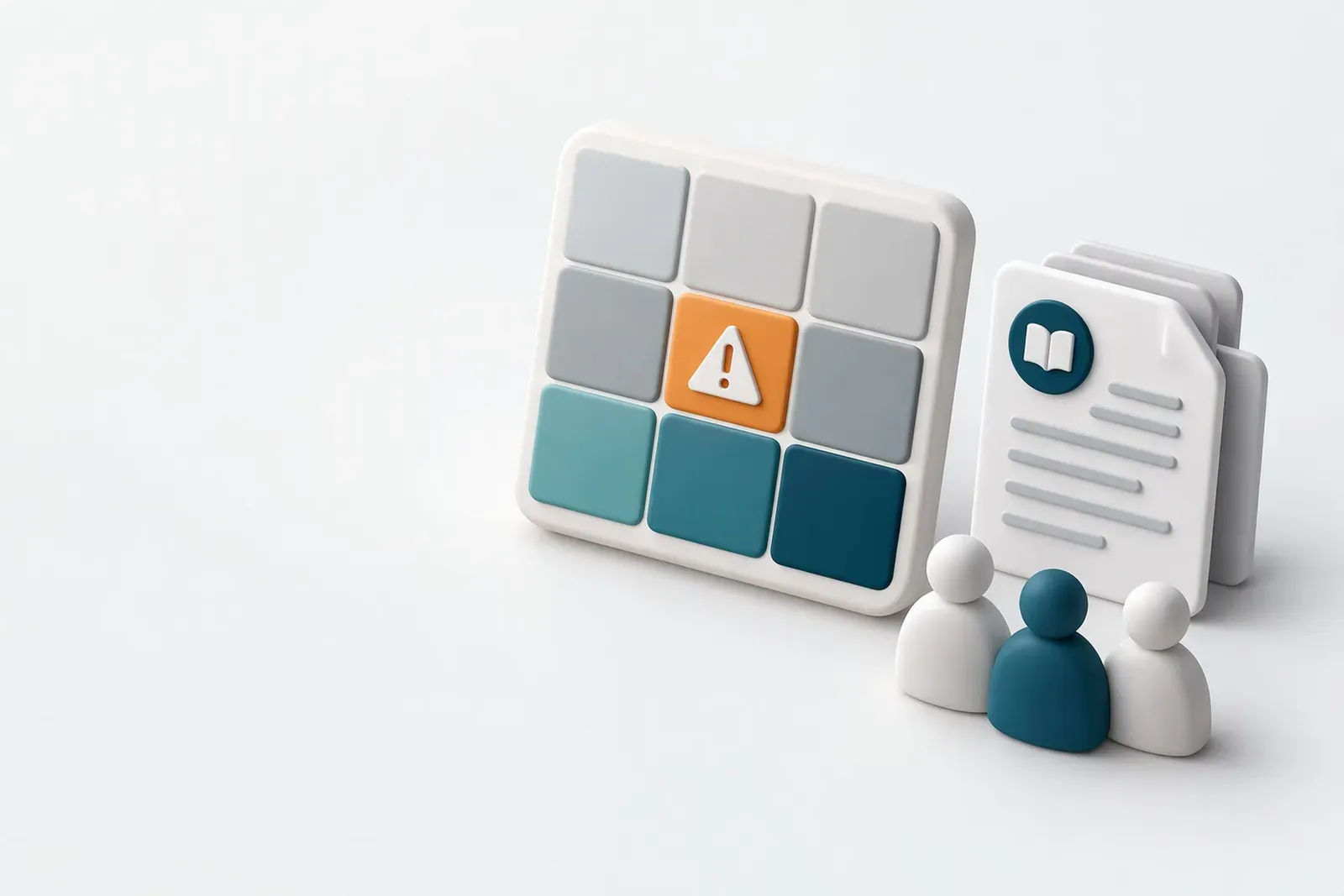
To assess the internal and external influences of these issues on their own company, decision-makers often use risk matrices. In these matrices, the risks that decision-makers see for their company are classified according to probability and impact.
Lack of knowledge as a business risk
This article focuses on reducing risks that arise from a lack of knowledge in the company. Indeed, the topic of knowledge management and information provision is playing an increasingly important role. Even now, simple tasks are increasingly being automated.
The human’s job is to supervise the machines and enable them to do their tasks well. But to do this, humans must have the necessary knowledge. If they do not, new risks arise for companies, which must be mapped accordingly in the risk matrices.
Finding knowledge instead of memorising it
Unlike in the past, this knowledge no longer has to be retrievable from memory. The information is all there, especially in the companies. There are learning management systems, intranets, project rooms and much more where all knowledge is digitised.
The employee’s job
- Find the appropriate information
- Make the best decisions for the company
The task of the company or the decision-maker
- “Empower” the employee to make exactly those decisions
Classifying the information risk in the risk matrix
One way to map the risk of not having the right information at hand in a risk matrix is to classify it as a medium probability, medium impact risk. For example, it could be placed in the middle of the risk grid, between the low probability and low impact risks and the high probability and high impact risks.
How to reduce the risk further
To further reduce the risk of not having information appropriately at hand, you could:
Frequently asked questions about business risk and information provision
Why is providing information becoming more important for companies?
Data growth and technological development have never been as fast as they are today. In addition, new working models through New Work require a new approach to knowledge and data. Simple tasks are increasingly automated, and people need the necessary knowledge to supervise the machines.
What is a risk matrix?
In a risk matrix, decision-makers classify the risks they see for their company according to probability and impact. It is often used to assess the internal and external influences of issues such as ESG and CSR.
Where does the risk of missing information belong in a risk matrix?
One way is to classify it as a medium probability, medium impact risk and place it in the middle of the risk grid. The ranking should be based on a realistic assessment of likelihood and impact.
Does knowledge still have to be retrievable from memory?
No. The information is available in companies, in learning management systems, intranets, project rooms and more. Employees have to find the appropriate information, and the company has to empower them to make the best decisions.
How can the risk of missing information be reduced?
By carefully collecting and properly documenting all relevant information, giving all people involved access to it, and better using and sharing the knowledge and experience of the people involved.