
Enterprise Search
Calculating a business case for an enterprise search
An example case with 400 office employees shows how much time and money internal information searches cost and how to calculate the business case for your company.

Internal research for information takes more time than most people in a company realise. This blog article provides support to calculate the case for an enterprise search in your own company.
As a basis for the calculations, we recommend using the first method of one of our two frameworks. The results obtained here are used to calculate the figures for your own company. If you would like to calculate your case and have not yet done so, then first carry out the survey described. Alternatively, you can use our figures and extrapolate them for your company.
To calculate the business case, there are various hard and soft factors. This article focuses on the calculation of the hard factors. Nevertheless, the soft factors should also be taken into account.
The soft factors
Besides the classic time savings, there are other soft factors to consider when introducing an enterprise search engine. These include:
This list can be extended, but it is intended as a thought-provoking impulse for further added value on a cultural level in addition to pure time savings.
The hard factors
The survey
In the survey already mentioned, we ask a question that serves as the basis for our calculations:
On average, how much time do you spend each day looking for internal information needed for work?
The possible answers are as follows:
- Less than 5 minutes
- 5-15 minutes
- 15-30 minutes
- 30-45 minutes
- 45-60 minutes
- More than 60 minutes
We have conducted the survey several times and the nice thing is that, as is so often the case, we have a Gaussian or normal distribution:
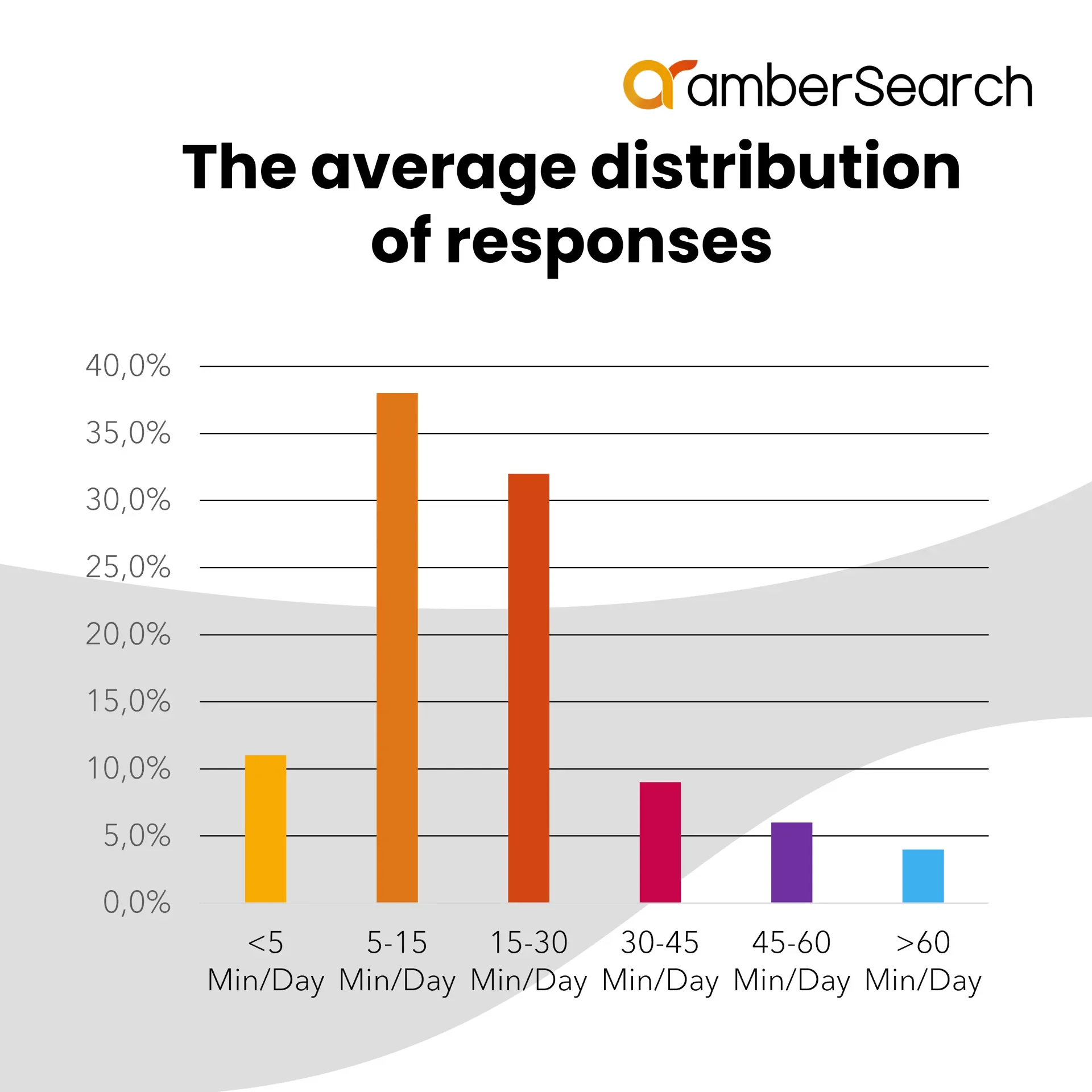
This distribution has been confirmed over several surveys and will probably also settle roughly in this range in your company.
Get the results of the whole study
Our example case
Let’s now take an example company with 400 employees in the office. Depending on the number of employees in your company, you can calculate the following steps accordingly with your numbers.
If we take the distribution presented and convert it to an absolute number of employees per category, we get the following absolute numbers:
| Daily search effort | Distribution | Absolute distribution [400 EMP] |
|---|---|---|
| Less than 5 minutes | 11% | 44 |
| 5-15 minutes | 38% | 152 |
| 15-30 minutes | 32% | 128 |
| 30-45 minutes | 9% | 36 |
| 45-60 minutes | 6% | 24 |
| More than 60 minutes | 4% | 16 |
Less than 5 minutes
- Distribution
- 11%
- Absolute distribution [400 EMP]
- 44
5-15 minutes
- Distribution
- 38%
- Absolute distribution [400 EMP]
- 152
15-30 minutes
- Distribution
- 32%
- Absolute distribution [400 EMP]
- 128
30-45 minutes
- Distribution
- 9%
- Absolute distribution [400 EMP]
- 36
45-60 minutes
- Distribution
- 6%
- Absolute distribution [400 EMP]
- 24
More than 60 minutes
- Distribution
- 4%
- Absolute distribution [400 EMP]
- 16
Table: Absolute distribution of employees per category with 400 office employees
If we convert the absolute distribution together with the answers given into the daily time spent (per hour), then the employees of a company with 400 office staff invest an average of 136.5 hours per day in internal research.
For comparison: In an 8-hour working day, that is 17 people searching full-time for internal information only.
| Answer options | Absolute distribution | Time waste [h/day] |
|---|---|---|
| Less than 5 minutes [5 min] | 44 | 3,7 |
| 5-15 minutes [10 min] | 152 | 25,3 |
| 15-30 minutes [22,5 min] | 128 | 48 |
| 30-45 minutes [37,5 min] | 36 | 22,5 |
| 45-60 minutes [52,5 min] | 24 | 21 |
| More than 60 minutes [60 min] | 16 | 16 |
| Sum [h/day] | 136,5 |
Less than 5 minutes [5 min]
- Absolute distribution
- 44
- Time waste [h/day]
- 3,7
5-15 minutes [10 min]
- Absolute distribution
- 152
- Time waste [h/day]
- 25,3
15-30 minutes [22,5 min]
- Absolute distribution
- 128
- Time waste [h/day]
- 48
30-45 minutes [37,5 min]
- Absolute distribution
- 36
- Time waste [h/day]
- 22,5
45-60 minutes [52,5 min]
- Absolute distribution
- 24
- Time waste [h/day]
- 21
More than 60 minutes [60 min]
- Absolute distribution
- 16
- Time waste [h/day]
- 16
Sum [h/day]
- Absolute distribution
- Time waste [h/day]
- 136,5
Table: Calculating the daily search time invested in a company with 400 office employees
Projection for a whole year
The next step is to determine a value for the whole year. We have done this in the following table:
| Projection | Time waste |
|---|---|
| Sum [in h/day] | 136,5 |
| Sum [in h/week] | 682,5 |
| Sum [in h/month] | 2.934,8 |
| Sum [in h/year] | 35.217,0 |
Sum [in h/day]
- Time waste
- 136,5
Sum [in h/week]
- Time waste
- 682,5
Sum [in h/month]
- Time waste
- 2.934,8
Sum [in h/year]
- Time waste
- 35.217,0
The factors for extrapolation were 5 (day to week), 4.3 (weeks to month) and 12 (month to year).
Justifiably, some people will now say that the values are too high, since no person actually sits at a PC 100% of the possible working days. We agree with this. To simplify the calculation a bit, we assume that employees spend about 40% of the time in training courses, at trade fairs, on holiday, sick, etc.
This makes 21,120 hours/year out of the calculated approx. 35,200 hours that are needed each year for internal research for information.
We can now multiply this value by an average, imputed hourly rate of 65€. The result is that companies lose 1,370,000 €/year because their employees (should) rather spend their time researching internal information, they are there anyway. At least that is the argumentation and mindset of some…
- per year spent on internal research with 400 office employees
- 21,120 h
- average, imputed hourly rate
- 65 €
- lost per year
- 1,370,000 €
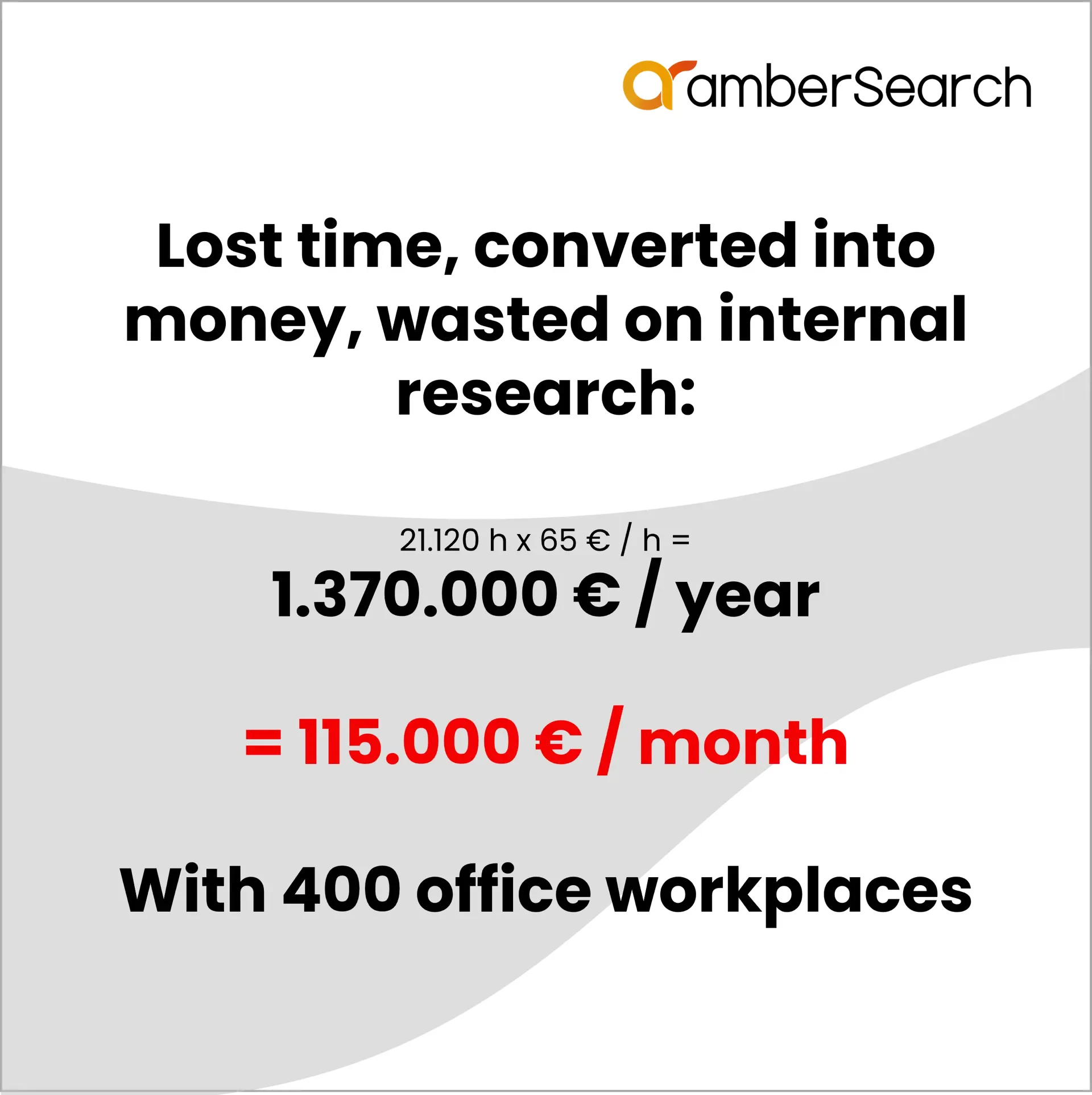
It is a pity that this is wasted capital, with which neither new, value-added projects can be implemented, nor can this money be invested in staff training. Much more could be done with this capital and especially with the time freed up for staff: reduction of stress for staff, new investments & Co…
What does this mean for you?
Probably your company does not have exactly 400 employees. Therefore, we have made a small 3-set calculation to give you a feeling for the values of your company size:
| Office workers [EMP] | Monthly lost cost |
|---|---|
| 50 | 14.375 € / month |
| 100 | 28.750 € / month |
| 200 | 57.500 € / month |
| 300 | 86.250 € / month |
| 500 | 143.750 € / month |
| 750 | 215.625 € / month |
50
- Monthly lost cost
- 14.375 € / month
100
- Monthly lost cost
- 28.750 € / month
200
- Monthly lost cost
- 57.500 € / month
300
- Monthly lost cost
- 86.250 € / month
500
- Monthly lost cost
- 143.750 € / month
750
- Monthly lost cost
- 215.625 € / month
Table: Extrapolation for other numbers of employees
If you want to calculate this for your company, then feel free to change the values accordingly and use the frameworks already presented to get further insights for your company. For a quick estimate, you can also use our ROI calculator.
How can we help with amber?
We are aware that we at amber will not be able to reduce this time to zero, no one can. Why? There will be one or two smaller data pots that cannot be connected for whatever reason or the employee simply does not have the access rights to access the desired information.
Nevertheless, with amber we offer an AI-based solution that can reduce this by up to 40% (according to some customers).
How would you invest one million saved for your company?
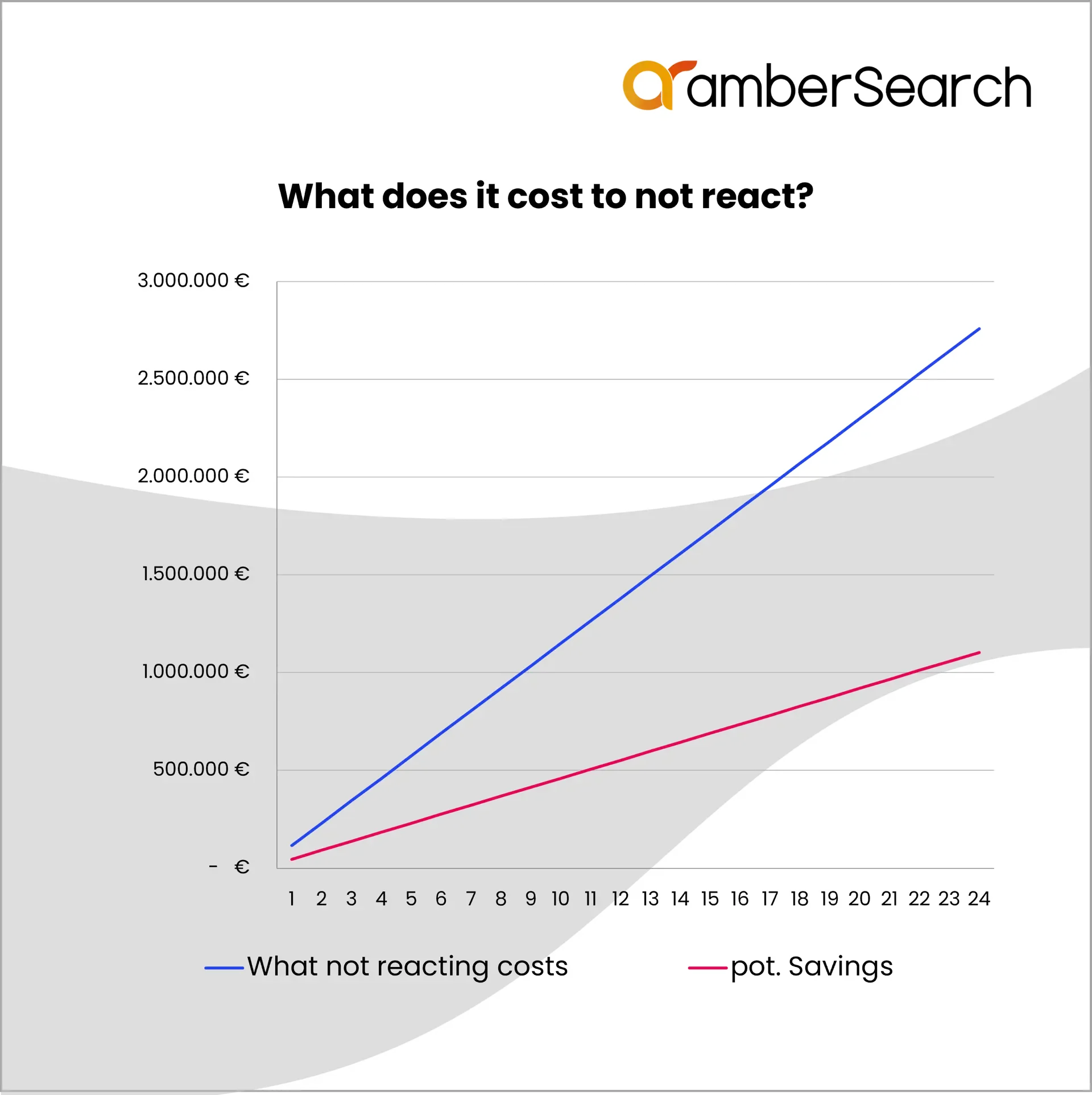
We have shown how a possible cost/benefit diagram could look in the diagram.
Frequently asked questions about the business case for enterprise search
Which factors go into the business case for an enterprise search?
There are hard and soft factors. The hard factors are the time employees spend searching for internal information, converted into money. Soft factors include increased employee satisfaction, reduced turnover, attracting talent, faster onboarding and new & remote work.
How much time do employees spend searching for internal information?
Our surveys show a normal distribution: 11% search less than 5 minutes a day, 38% 5-15 minutes, 32% 15-30 minutes, 9% 30-45 minutes, 6% 45-60 minutes and 4% more than 60 minutes. With 400 office employees, that is an average of 136.5 hours per day, or 17 people searching full-time for internal information only.
How do you project the daily search time to a whole year?
The hours per day are multiplied by 5 (day to week), 4.3 (weeks to month) and 12 (month to year). In the example, 136.5 hours per day add up to approx. 35,200 hours per year. Assuming about 40% of the time is spent in training courses, at trade fairs, on holiday, sick, etc., 21,120 hours per year remain.
How much money does internal searching cost a company with 400 employees?
At an imputed hourly rate of 65€, a company with 400 office employees loses 1,370,000 € per year, or around 115,000 € per month. For 50 employees it is 14,375 € per month, for 750 employees 215,625 € per month.
How much can an enterprise search reduce search time?
Search time cannot be reduced to zero, because there will always be data pots that cannot be connected or employees who lack the access rights. According to some customers, amber reduces it by up to 40%.