
AI Agents & Assistants
What is a multi-agent system?
Multi-agent systems are the logical development of classic AI agents. You can find out what these systems can do and what their purpose is in this blog article.
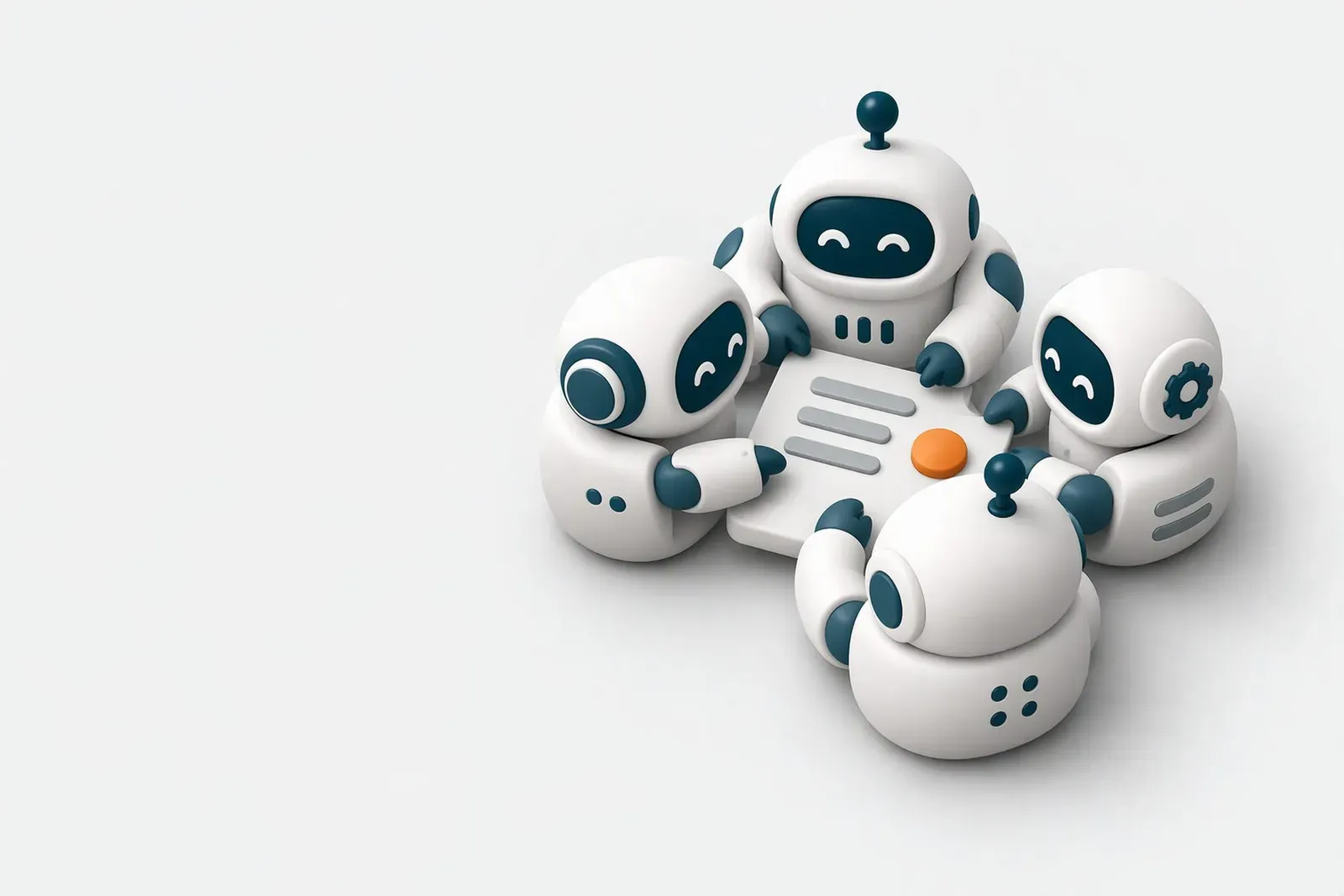
A multi-agent system is a decentralised AI system in which several autonomous AI agents interact with each other in order to solve tasks or achieve goals together.
This sounds relatively abstract at first, which is why we will take a closer look at the areas of application and the purpose of a multi-agent system in this blog article.
Definition and basic concept
A multi-agent system initially consists of several individual AI agents. Each individual AI agent has a specific specialisation in which it is very good. Depending on the task to be solved, an AI agent is then selected in a multi-agent system to solve the task. However, several AI agents may also have to interact with each other to solve the task. Through interactions, AI agents can exchange information and act cooperatively or competitively.
The aim of a multi-agent system is to solve tasks as efficiently and cost-effectively as possible. There are multi-agent systems because individual AI agents are not flexible enough to solve all the tasks that are set for a generative AI system. This is why several AI agents are used, which divide up the tasks according to their respective skills. This also allows AI systems to be smaller and more efficient, which saves costs.
Example of a multi-agent system
The following is a possible example of a multi-agent system: A company wants to implement an AI chatbot for its employees. This AI chatbot should solve various tasks. These include, for example:
- writing marketing texts, job advertisements and blog posts
- searching for specific information on a topic
- comparing certain documents
- as a training partner for employees
- as a support contact for customers
- …
A single LLM is basically able to solve the tasks with the help of a retrieval augmented generation system. But it will not be able to perform the respective tasks as well as specialised agents. In a multi-agent system, an AI agent would now decide which AI agent would be selected to solve the challenge.
| Prompt | Solved by |
|---|---|
| “Find me all the information about our customer X!” | AI agent 2 |
| “Formulate a cold call email to persona Y” | AI agent 1 |
| “Compare document A with document B” | AI agents 2 and 3 jointly |
“Find me all the information about our customer X!”
- Solved by
- AI agent 2
“Formulate a cold call email to persona Y”
- Solved by
- AI agent 1
“Compare document A with document B”
- Solved by
- AI agents 2 and 3 jointly
The comparison would be solved jointly by agents 2 and 3, as AI agent 2 would search for the two documents and AI agent 3 would then compare the documents found.
Properties of a multi-agent system
To be a multi-agent system, an AI system must be able to demonstrate various properties. These include:
Advantages of multi-agent systems
Multi-agent systems offer a number of advantages – also in comparison to single-agent systems:
You want to introduce AI in your company?
We’ve created a white paper that outlines best practices for integrating AI into your company. It focuses on what really matters: connecting AI with your existing IT infrastructure and core knowledge – not just using AI on a superficial level.
Areas of application
There are various use cases for such systems that do not have to be purely software-driven. Many use cases also work because physical elements, such as cars or robots, are controlled by AI agents. The following examples (in addition to the example given above) should therefore be seen as a small selection of use cases:
Robotics
Co-operative teams of robots working together to perform tasks such as search and rescue missions.
Traffic control
Intelligent traffic management systems in which vehicles and traffic infrastructures work together.
E-commerce
Recommendation systems and auctions in which autonomous agents act on behalf of users.
Game theory and simulation
Models for analysing and predicting complex systems such as financial markets or social networks.
Challenges of multi-agent systems
As with all AI systems – shit in, shit out. A good data structure is therefore very important as the basis for such systems. The following challenges must then be taken into account when designing multi-agent systems:
The further development of multi-agent systems
In the age of AI, simple chatbots will no longer be sufficient in the medium term and more complex solutions will be needed in companies that can also take over tasks automatically. By 2024, realism had already set in at many companies – a single AI chatbot with its own data will not take anyone’s job or solve tasks independently. Such systems are assistance systems. This is what the future of multi-agent systems could look like:
The great advantage of such systems lies in their intelligent combination with each other and their integration into the company’s internal processes.
Frequently asked questions about multi-agent systems
What is a multi-agent system?
A multi-agent system is a decentralised AI system in which several autonomous AI agents interact with each other in order to solve tasks or achieve goals together. Each agent has a specific specialisation in which it is very good.
Why use several AI agents instead of one?
Individual AI agents are not flexible enough to solve all the tasks that are set for a generative AI system. Several agents divide up the tasks according to their respective skills. This also allows AI systems to be smaller and more efficient, which saves costs.
What properties does a multi-agent system have?
Autonomy, communication, cooperation and heterogeneity: the agents act independently, exchange information via protocols, work together towards common goals and can have different skills, knowledge and roles.
What are the advantages of multi-agent systems?
They are flexible and scalable, remain functional if individual components fail, organise and coordinate themselves and can react in real time without human monitoring.
Where are multi-agent systems used?
For example in robotics, traffic control, e-commerce, and game theory and simulation, such as analysing financial markets or social networks. An AI chatbot for employees can also be built as a multi-agent system.
What are the challenges of multi-agent systems?
Coordination effort, resolving conflicts between agents with different goals, communication costs and security. A good data structure is also essential, because here too: shit in, shit out.