
AI Strategy & Compliance
Private AI – Should you train Large Language Models with your own data?
What exactly is private AI, and does it make sense to train Large Language Models (LLMs) with your own data?

In 2023, the term “Private AI” became more and more important. But what exactly is private AI, why is it being talked about and is it really the optimal solution? In this article, we dive deep into the topic and shed light on the question of whether it makes sense to train Large Language Models (LLMs) with your own data.
In 2023, the state of generative AI was one of progress and opportunity. Companies were faced with the challenge of how best to use the potential of these models, such as GPT-4, in combination with their internal know-how. Here, a central question emerges.
The challenge: Private or Public AI?
When companies decide to use AI models, they are faced with the choice of training them themselves with in-house data or relying on the services of large providers such as Google (Bard), OpenAI or open-source models. The hurdles and concerns here are manifold and partly due to a lack of technical understanding. Let’s clear the air!
If you are considering using generative AI, you should read our blog article on the introduction of generative AI.
What does Private AI mean?
Private AI describes the practice of training algorithms exclusively with data owned by an individual user or organisation. For example, when a machine learning system trains a model on a dataset of documents such as invoices or tax forms, that model remains solely for the internal purposes of the organisation.
The main advantage is that this avoids creating a common knowledge base from which potential competitors could also benefit.
And what is Public AI?
Public AI refers to AI algorithms that are trained on large amounts of publicly available data. This data usually comes from different users or customers. A well-known example is ChatGPT, which is based on information from the freely available internet such as text articles, images and videos. Public AI can also include algorithms that use data sets that are not specific to a particular user or company.
The illusion of one’s own: Training with your own data?
Many companies tend to take the supposedly safe route and want to train an AI model with their own data. They hope to share internal knowledge efficiently through a question-answer system. But there are various difficulties lurking here:
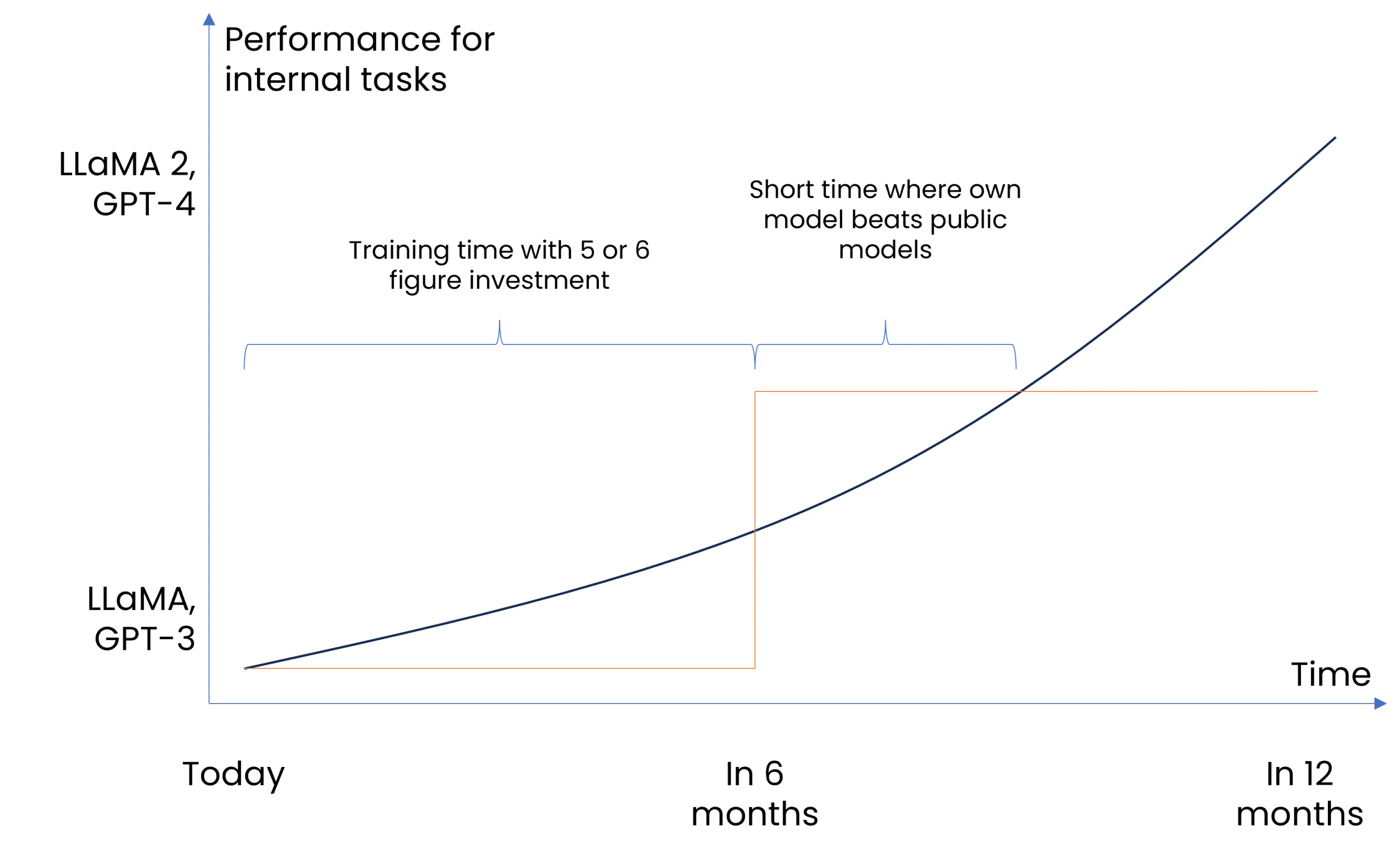
Basically, a model is only as good as its data. If only a data set is selected that is created from data that is accessible to all employees, then the response depth will not be particularly deep. On the one hand, this means that the system is not as strong as it could be and, on the other hand, employees use the system less or not at all. On the other hand, if “too much” data is used, then certain employees may receive information that was not actually intended for them (e.g. turnover with a customer, etc.).
A better solution to imitate a private AI: Enterprise search meets generative AI
Instead of falling into the pitfalls of one’s own training, a more effective alternative presents itself: Retrieval Augmented Generation. One can use the context that an enterprise search – in our case amber – recognises as the context for a generative AI model. The advantage is that the transfer of the context consumes virtually no computing time, which makes this set-up extremely powerful.
From a technical point of view, the enterprise search would pick out all relevant information, taking into account topicality and access rights. This is then passed to an AI model as a context.
Instead of having to provide an answer from its own knowledge (without taking access rights into account), the artificial intelligence of the generating model is used to generate the right information from a defined context (access rights are taken into account). This is exactly what we do with amberAI.
To achieve this effect, we rely on public AI – but in an open-source variant. The open source model we use was refined without customer data (!) so that it is perfectly adapted to our customers’ use cases. So we use AI models that are trained with public data, but apply them exclusively for internal use cases. In this way, our customers retain data sovereignty, but can use the broad knowledge of the public to exploit comparable effects as with private AI. After that, the only question is where such a solution should be hosted.
With this approach, we beat several challenges that arise when training our own AI model:
In short, our alternative works through the interaction of amber and an open-source AI model that we have fine-tuned and that has general intelligence. The search determines relevant information based on access rights and timeliness. The generative model uses context to provide accurate answers without needing to be trained itself.
And this is what a solution might look like: watch the video “What is amberAI: A few use cases” on Loom
Conclusion: Enterprise search instead of a self-trained private AI
In conclusion, the private AI route with its own training effort is often not the most efficient. The combination of enterprise search and generative AI models offers a better solution. Companies should not fall into the trap of putting unnecessarily large amounts of data into their own models when an intelligent combination can deliver the desired output, and when training their own AI models mainly benefits one group of companies: cloud providers.
Frequently asked questions about private AI
What is private AI?
Private AI describes the practice of training algorithms exclusively with data owned by an individual user or organisation. The model remains solely for the internal purposes of the organisation, which avoids creating a common knowledge base that competitors could also benefit from.
What is the difference between private AI and public AI?
Public AI is trained on large amounts of publicly available data, usually from different users or customers, such as ChatGPT with information from the freely available internet. Private AI is trained only with data owned by one user or organisation.
Why is training an AI model with your own data difficult?
A trained model cannot take access rights into account, selecting the right data is complex, training can run into the high five or six figures, in-house models quickly become outdated, their answers are hard to verify without references, and the necessary expertise is often lacking.
What is the alternative to training your own AI model?
Retrieval Augmented Generation: an enterprise search picks out all relevant information, taking into account topicality and access rights, and passes it to a generative AI model as context. The model generates the answer from this context without being trained on company data itself.
What are the benefits of combining enterprise search and generative AI?
Answers can be referenced to their sources, information is up to date, access rights are respected, no in-house model training is needed, the solution is cost-efficient and you do not need your own experts.